
INSISST: building shared learning and stronger social innovation ecosystems across Europe
The NCCSI project (2024 – 2027) is a transnational initiative (INSISST Consortium), aimed at strengthening the social innovation sector and the development of National Competence Centres for Social Innovation in each Member State. Read more below of how the INSISST consortium has made progress in strengthening the role of Social Innovation National Competence Centres across Europe since 2024.

Since starting the project in July 2024, the INSISST consortium has made strong progress in strengthening the role of Social Innovation National Competence Centres across Europe. While each country is developing its own national track, the international work packages have helped us build a shared foundation: a common learning space, a clearer understanding of impact, and a clearer view on how to make visible the voice for social innovation in policy debates.
The coordination of the project is now firmly in place. Regular consortium meetings, clear planning tools and shared reporting structures have helped partners stay aligned across countries and work packages. This may sound administrative, but it is important: social innovation work is complex, and good coordination creates the trust and clarity needed for real collaboration.
The heart of the transnational work has been peer learning. Through the Dynamic Learning Agenda, the consortium has collected and updated the key questions that matter most to NCCSIs: how to engage ecosystems, how to measure impact without oversimplifying it, how to support scaling, and how to develop sustainable revenue models for competence centres. The internal knowledge repository, “The Source”, is becoming a shared place where partners collect tools, cases, methods and learning materials. Live workshops and online sessions have created space to exchange very practical experience on ecosystem mapping, Theories of Change, stakeholder engagement, EU funding, international scaling, impact measurement, revenue models, social innovation narratives, SROI and new ways of thinking about money and value.
A key lesson is that NCCSIs do much more than support individual projects. They help build the conditions in which social innovation can happen: trusted relationships, better connections between sectors, stronger capacities, clearer narratives, access to knowledge, and bridges between innovators, policymakers, funders, researchers and civil society. This is especially relevant for policymakers and ecosystem partners: supporting social innovation is not only about funding good ideas, but also about investing in the infrastructure that allows these ideas to grow, adapt and become part of broader system change.
INSISST has also made important progress in understanding and measuring the impact of NCCSIs. All national competence centres developed Theories of Change, and these have been translated into a shared but flexible monitoring and evaluation approach. The consortium deliberately avoids a one-size-fits-all model. Instead, partners work with a common backbone while keeping room for national differences. The approach looks at three levels of change: micro-level changes for innovators and initiatives, meso-level changes in ecosystems and support organisations, and macro-level changes in policy, funding and institutional conditions. The main message is clear: impact measurement should be “simple but serious”. It should provide evidence, but also support learning, adaptation and better decision-making.
The Stakeholder Panel has played a role in keeping the project connected to real ecosystem needs. Stakeholders from public authorities, foundations, research, social innovation practice and support organisations confirmed the importance of institutionalising NCCSIs as long-term infrastructure. They also stressed that social innovation needs stronger political narratives, more flexible funding models, better cross-ministerial coordination, and impact measurement that is useful without becoming a burden for innovators.
In the sustainability work, INSISST compared the working and revenue models of the different NCCSIs. One shared conclusion is emerging: competence centres should not be treated as temporary project structures. Their core functions (i.e. ecosystem convening, capacity building, impact learning, policy feedback and transnational exchange) create public value and therefore need stable support. At the same time, many SINCCs will need mixed revenue models, combining public funding with complementary sources such as philanthropy, memberships, paid services, regional funding or blended finance, while carefully avoiding mission drift.
Finally, INSISST has strengthened its communication and advocacy work. A shared communication strategy, common templates and position papers help the consortium speak with a clearer voice. The aim is not only to report on activities, but to explain why social innovation matters: for inclusive transitions, democratic resilience, stronger communities and better responses to complex societal challenges.
For other SINCCs and ecosystem actors, the main lesson is this: social innovation needs more than isolated projects. It needs places, people and structures that connect, translate, support, learn and advocate. That is the role INSISST is helping to make visible — nationally and across Europe.
Irish-Specific Context
In 2025, Ireland made significant progress in advancing the National Competence Centre for Social Innovation (NCCSI) as part of the EU-supported INSISST Consortium. Building on the earlier FUSE project (2021–2023), which mapped Ireland’s social innovation ecosystem, Rethink Ireland and Genio – endorsed by Government and working in collaboration with the Department of Rural and Community Development and the Gaeltacht (DRCDG) and the Department of Further and Higher Education, Research, Innovation and Science (DFHERIS) – continued to lead the development of a robust national model for social innovation.
Throughout the year, interviews were conducted with seven NCCSIs across Europe to understand their governance structure, functions and operations to inform the development of an Irish model.
In autumn 2025, the first Consultative Advisory Group meeting was convened, bringing together 15 experts from across the public and private sectors, academia, and civil society to guide the initiative. Two cross-sectoral subgroups were also established: one to pilot a Social Innovation Database and another to develop and test a National Methodological Framework for Social Impact Assessment, with kick-off meetings held early in 2026.
The Action Research Group, led by Genio, completed interviews with public and NGO stakeholders and began engaging academic representatives, with findings informing the design of a new Accelerator Programme.
A Communications Strategy was also commissioned and brought to final stages of development to raise awareness of social innovation and the role of the NCCSI.
Ireland remained actively engaged at European level, with Genio and Rethink Ireland representing the country at multiple online and in-person events, including a Mutual Learning event in Malmö, Sweden. The project team also attended study visits in Brussels, Madrid and Poland.
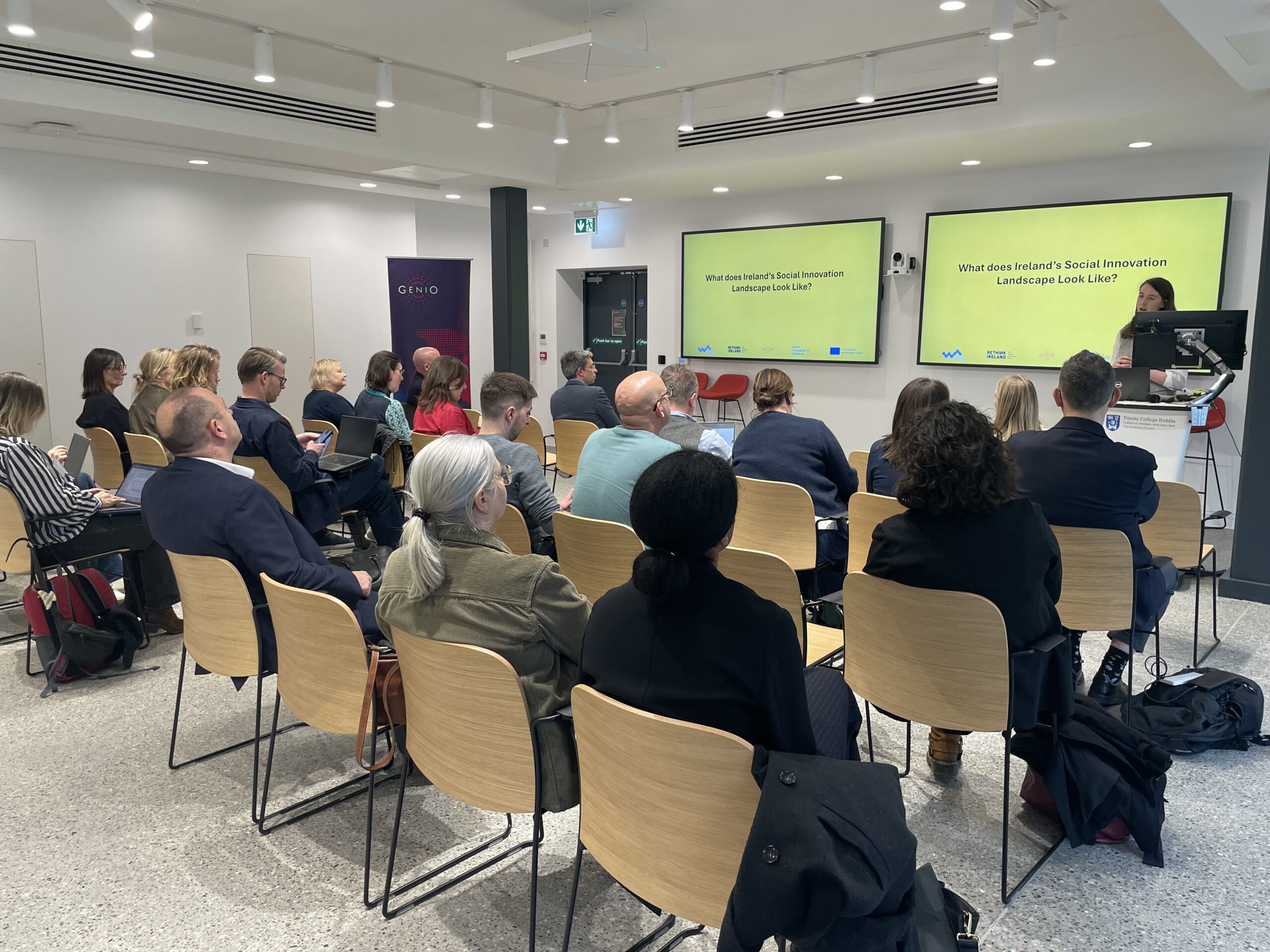
Finally, from March 11-13 2026, we were delighted to host our INSISST consortium partners in Dublin for a study visit focused on the national social innovation ecosystem.
Study visits such as this remind us that meaningful collaboration, grounded in openness and mutual learning, is itself a form of innovation
– Emily O’Flynn, Rethink Ireland about INSISST consortium partners visit to Dublin March 2026.


